
Most team building activities fail for the same reason. They are booked to fill a slot, not to fix anything. A group that never talks across departments gets a trust fall. A team that already likes each other gets forced fun. This collection is sorted by what you actually have to work with. How much time you have, whether people are in one room, and how many of them there are. Every entry says how to run it.
Nothing here needs a facilitator or a budget line. Pick the section that matches your constraint and read the eight ideas under it. If you are naming the teams you split into, our team name generator handles that part. We also have lists for marketing teams, sales teams and engineering teams.
Fun Team Building Activities
Start here if you have no specific problem to solve. The best fun team building activities get people talking sideways instead of up and down the org chart. None of these need a debrief.
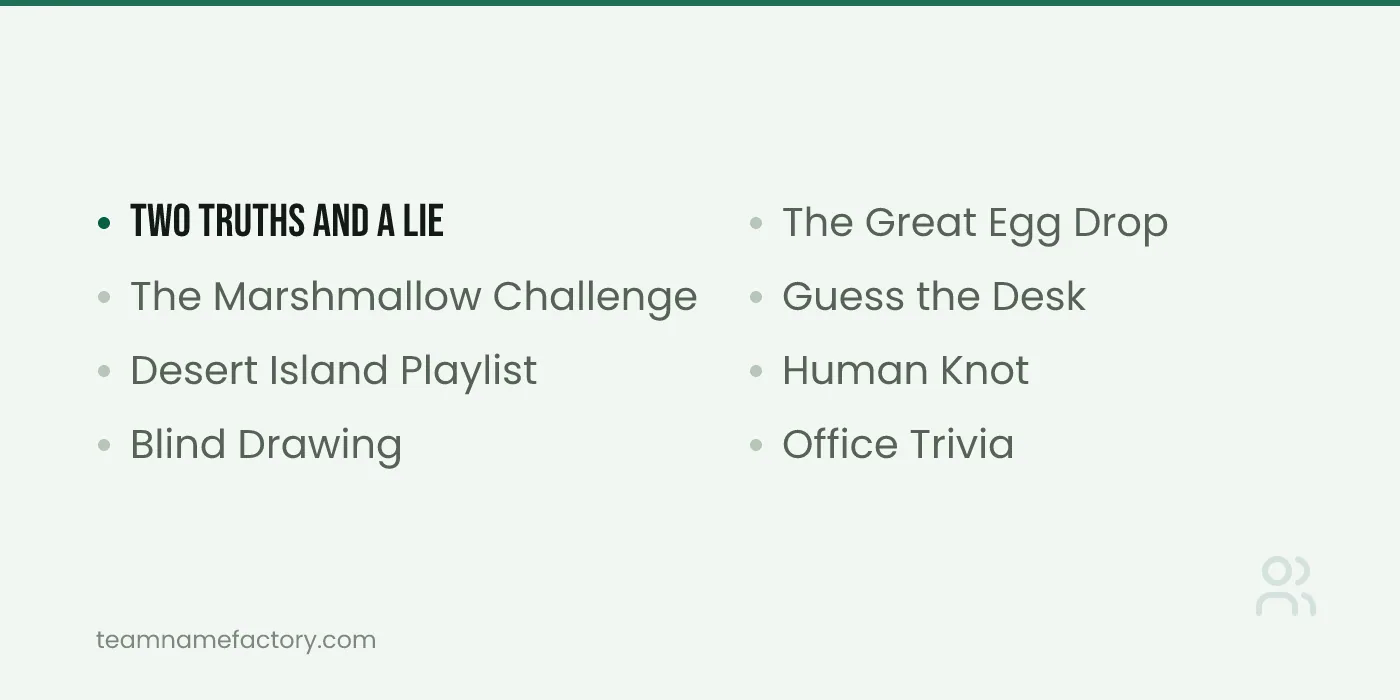
- Two Truths and a Lie — Each person gives three statements and the group votes on the false one. Ten minutes for a team of eight, and it works cold with no setup.
- The Marshmallow Challenge — Teams of four build the tallest freestanding tower from twenty sticks of spaghetti, tape, string and one marshmallow. Eighteen minutes. The marshmallow goes on top, which is the part everyone forgets.
- Desert Island Playlist — Everyone adds two songs to a shared playlist and the group guesses who added what. Runs in the background all week.
- Blind Drawing — Pairs sit back to back. One describes an image, the other draws it without asking questions. Five minutes, then swap. It exposes how much people assume when they brief each other.
- The Great Egg Drop — Teams build a casing from newspaper, straws and tape, then drop the egg from a first-floor window. Thirty minutes including the drop.
- Guess the Desk — Everyone submits a photo of their workspace and the group matches desks to people. Works just as well with home offices.
- Human Knot — Eight to twelve people grab two random hands across a circle and untangle without letting go. Ten minutes, and it stalls in a useful way.
- Office Trivia — Questions about the company and the people in it, not general knowledge. Someone has to write it, which takes about an hour, but it beats a bought quiz every time.
Quick Team Building Activities You Can Run in 5 Minutes
These are the 5-minute team building activities that fit at the top of a meeting. Use one to open a session that would otherwise start with silence. Short does not mean pointless, but it does mean you should not attempt a debrief.
- One Word Check-In — Each person gives a single word for how their week is going. No follow-up questions unless they offer. Ninety seconds for a team of ten.
- Rose, Thorn, Bud — One good thing, one problem, one thing you are looking forward to. It surfaces blockers faster than a status round.
- Count to Twenty — The group counts to twenty with no order agreed and no two people speaking at once. If two overlap, start again. It is harder than it sounds.
- Emoji Status — Everyone posts three emoji describing their current project. Others guess the project. Works in any chat tool.
- Would You Rather — One question, everyone answers, no debate. “Would you rather present to the board or write the deck?” gets more honesty than it should.
- The Ten-Second Demo — One person shows one thing they built or fixed since the last meeting. Rotate weekly. It quietly builds a habit of sharing work early.
- Common Ground — In breakout pairs, find three things you share that are not work related. Three minutes, then report one back.
- Highs and Lows — Best and worst moment of the week, one sentence each. Keep the low genuine or the exercise dies.
Indoor Team Building Activities
Weather-proof and room-bound. Good indoor team building activities need a table, a wall or nothing at all. Check the ceiling height before anything involving throwing.
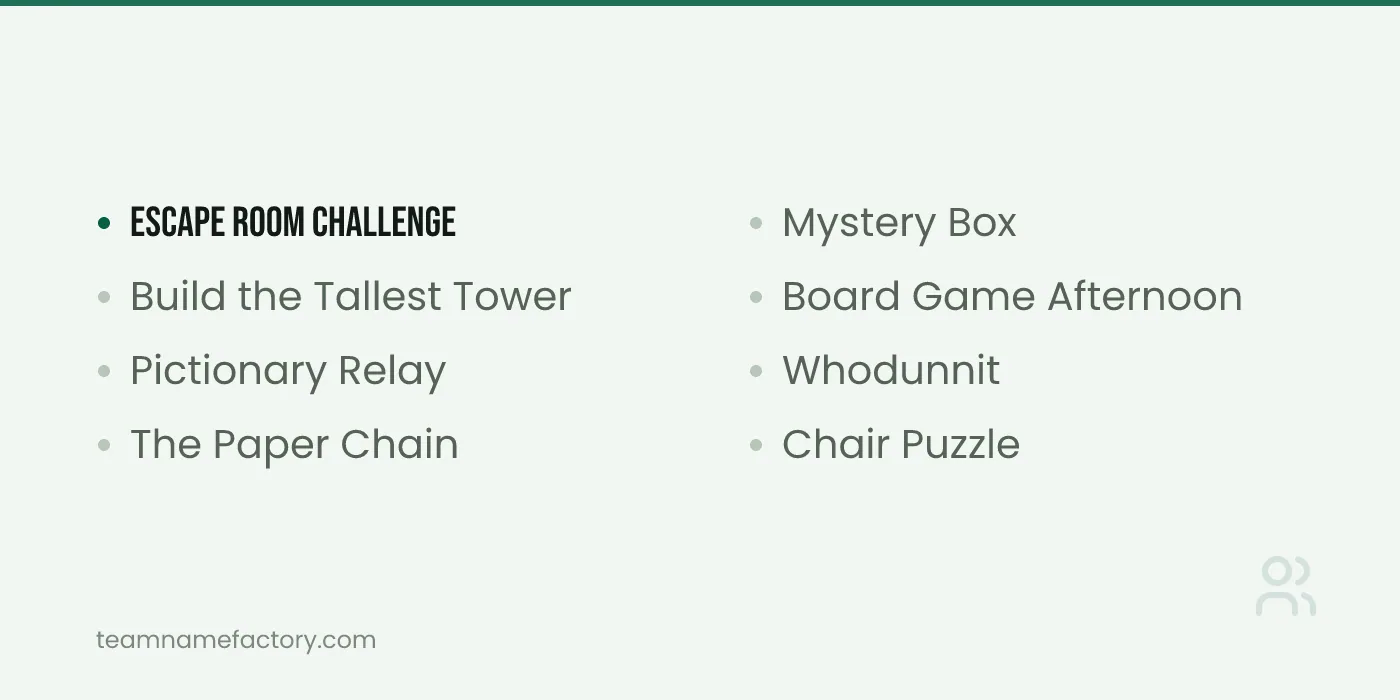
- Escape Room Challenge — Either book a venue or run a boxed kit in a meeting room. Sixty minutes, teams of six. Split a larger group so nobody spectates. If you need a name for each team, our escape room team names list is built for exactly this.
- Build the Tallest Tower — Index cards and tape only. Fifteen minutes. Cheaper than the spaghetti version and it fails in more interesting ways.
- Pictionary Relay — Teams line up, one person draws, the rest guess, then the drawer rotates. Twenty minutes and it gets loud.
- The Paper Chain — Teams get identical paper, scissors and tape, and fifteen minutes to make the longest chain. It rewards a plan over speed, which is the whole point.
- Mystery Box — Each team gets a box of unrelated objects and ten minutes to pitch a product using all of them. Two-minute pitches.
- Board Game Afternoon — Pick cooperative games over competitive ones. Pandemic and Forbidden Island make a team negotiate instead of beat each other.
- Whodunnit — A printed mini murder mystery with a character each. Ninety minutes, best for eight to twelve people who already know each other.
- Chair Puzzle — Line up chairs and have the group reorder themselves by birthday, or height, without touching the floor. Ten minutes.
Outdoor Team Building Activities
Fresh air changes the dynamic more than most facilitators expect. These outdoor team building activities need open space but not a purpose-built course. The most fun outdoor team building activities are the ones with a clear finish line. Have a wet-weather fallback ready before you announce anything.
- Scavenger Hunt — Teams work a list of photo challenges around a park or a neighborhood. Ninety minutes. Our scavenger hunt team names list saves the five minutes everyone spends arguing about it.
- Tug of War — Obvious and still effective. Best of three, mixed teams, and check the rope.
- Orienteering Course — Map, compass and six checkpoints. Two hours. It splits a group by who admits they are lost.
- The Great Raft Build — Barrels, planks and rope, then float it. Needs water access and supervision, so treat it as a full afternoon.
- Field Day — Sack races, egg and spoon, three-legged race. Deliberately unserious, and the nostalgia does most of the work.
- Volunteer Build Day — A community garden or a trail clear-up. Half a day, and it is the only activity on this list people mention a year later.
- Geocaching Trail — GPS coordinates and small hidden containers. Teams of three, two hours, minimal setup once the caches are placed.
- Outdoor Cook-Off — Teams get the same ingredients and a grill. Ninety minutes plus eating. It gets naturally competitive without anyone being told to compete.
Virtual Team Building Activities
The failure mode here is a call where four people talk and twenty watch. Good virtual team building activities either use breakout rooms or give every person something to click. Keep the whole thing under forty minutes.
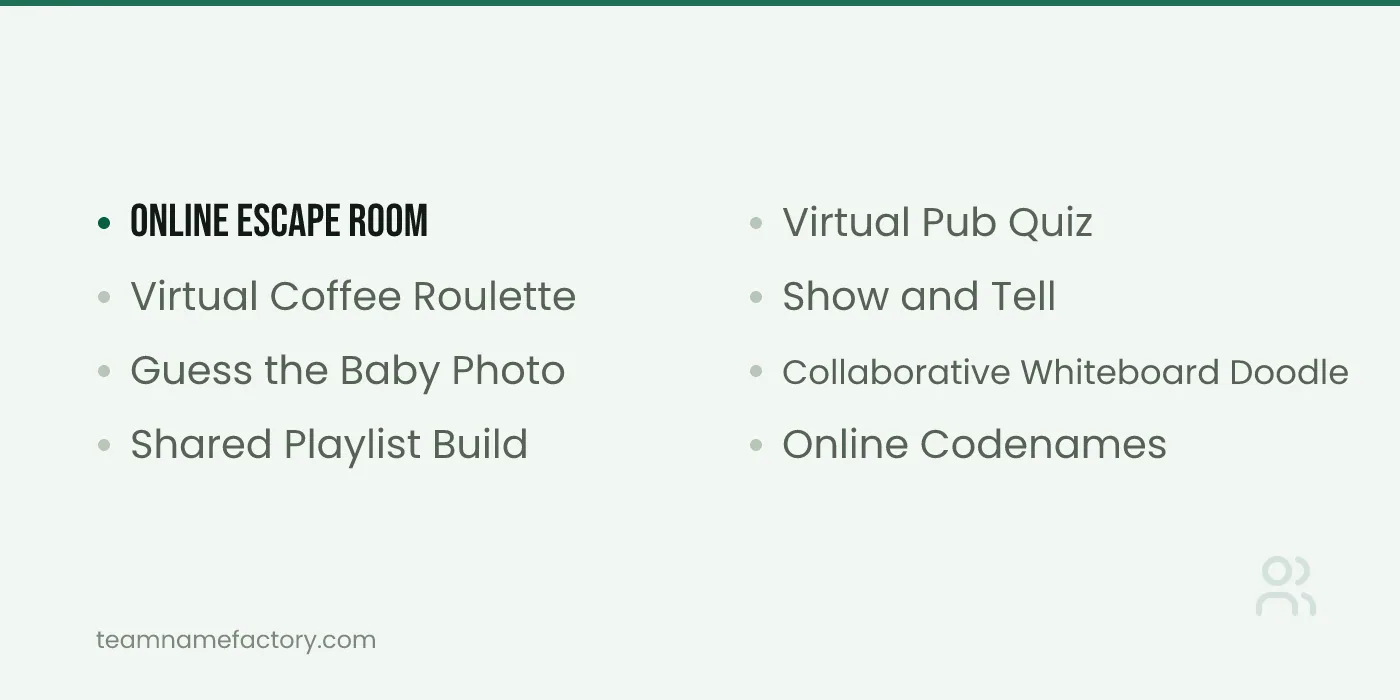
- Online Escape Room — Hosted digital rooms run for teams of four to six. Sixty minutes and the puzzles force people to share screens.
- Virtual Coffee Roulette — A bot pairs two random people for a fifteen-minute call each week. It is the lowest-effort thing on this page and consistently the most effective.
- Guess the Baby Photo — Everyone submits one, the group votes. Ten minutes, and it needs a volunteer to collect photos privately.
- Shared Playlist Build — Each person adds one song with a one-line reason. Play it during the next all-hands.
- Virtual Pub Quiz — Breakout rooms as teams, a shared answer sheet, six rounds. Forty-five minutes. Rounds of eight questions, not twenty.
- Show and Tell — One person brings an object from their desk and takes two minutes on it. Rotate. It works because it is about a thing, not about them.
- Collaborative Whiteboard Doodle — Everyone draws on one shared board to a prompt. Five minutes, and the mess is the output.
- Online Codenames — Two teams, a word grid, one clue-giver each. Twenty minutes and it genuinely rewards knowing how your teammates think.
Remote Team Building Activities Across Time Zones
When the team never overlaps, live calls stop being the answer. These remote team building activities run asynchronously, so nobody joins at eleven at night.
- Async Photo Prompt — A weekly prompt in a channel: your view, your mug, your commute. People post whenever they log on.
- The Question of the Week — One low-stakes question posted Monday, answered whenever. Rotate who picks it.
- Recipe Exchange — Each person shares a dish from where they live. It travels well across cultures and time zones.
- Kudos Board — A running channel where people post specific thanks. Specific is the operative word; “great job team” adds nothing.
- Book or Article Club — One short read a month with a comment thread instead of a meeting.
- Step Challenge — A month-long count with a shared leaderboard. It runs itself once started.
- Virtual Desk Tour — A short video walkthrough of where someone works, posted async. Three minutes each, one a week.
Team Building Activities for Work
These are the team building activities for work that survive a skeptical room. Each produces something the team can point at afterwards. That output is what separates genuinely fun team building activities for work from forced fun.
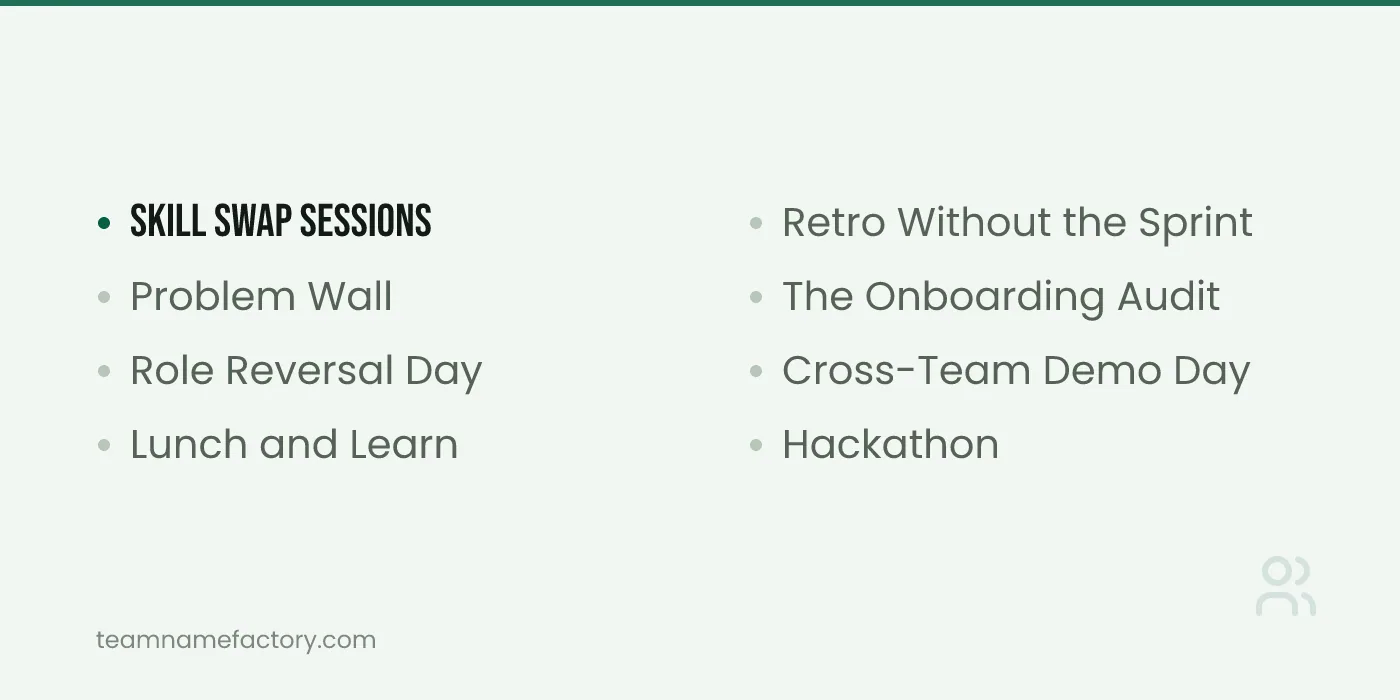
- Skill Swap Sessions — Each person teaches the team one thing they are good at in twenty minutes. It surfaces expertise managers did not know they had.
- Problem Wall — Everyone posts one process annoyance on a wall or board. The team votes on three and fixes them. Ninety minutes, and it is the rare activity with a measurable output.
- Role Reversal Day — People shadow a colleague in a different function for two hours. It ends most of the “why does that take so long” arguments.
- Lunch and Learn — One presenter, one topic, food provided. Forty-five minutes, monthly.
- Retro Without the Sprint — A structured what-worked and what-did-not on something that is not a sprint, like a launch or a hire. An hour.
- The Onboarding Audit — The newest hire walks the team through what confused them in week one. Uncomfortable and extremely useful.
- Cross-Team Demo Day — Two teams that rarely interact each show what they are building. An hour, quarterly.
- Hackathon — One day, free choice of project, demos at the end. Our hackathon team names list covers the naming.
Corporate Team Building Activities
Larger budget, more stakeholders, more people who did not choose to be there. Corporate team building activities need to work for someone who will not join in, so build in a role for observers.
- Charity Bike Build — Teams assemble children’s bikes that get donated at the end. Half a day. The reveal, when the recipients arrive, is the whole event.
- Cook-Off Competition — Teams cook against a clock with a judging panel. Three hours including the eating.
- Escape Room Tournament — Several teams run the same room and times are compared. Works for thirty to sixty people across a morning.
- Company Olympics — Six short stations, teams rotate on a whistle. Two hours, scales to a hundred people, and stations run in parallel so nobody queues.
- Improv Workshop — A professional facilitator, ninety minutes. It is the most divisive item here, so make participation genuinely optional.
- Strategy Simulation — Teams run a mock business against each other over several rounds. Half a day, and it suits senior groups who resist anything sillier.
- Escape the Boardroom — A kit-based puzzle run in your own meeting rooms. Cheaper than a venue and it scales in parallel.
- Film Festival — Teams write, shoot and edit a two-minute film on their phones. Three hours, then screen them all.
Team Building Activities for Small Groups
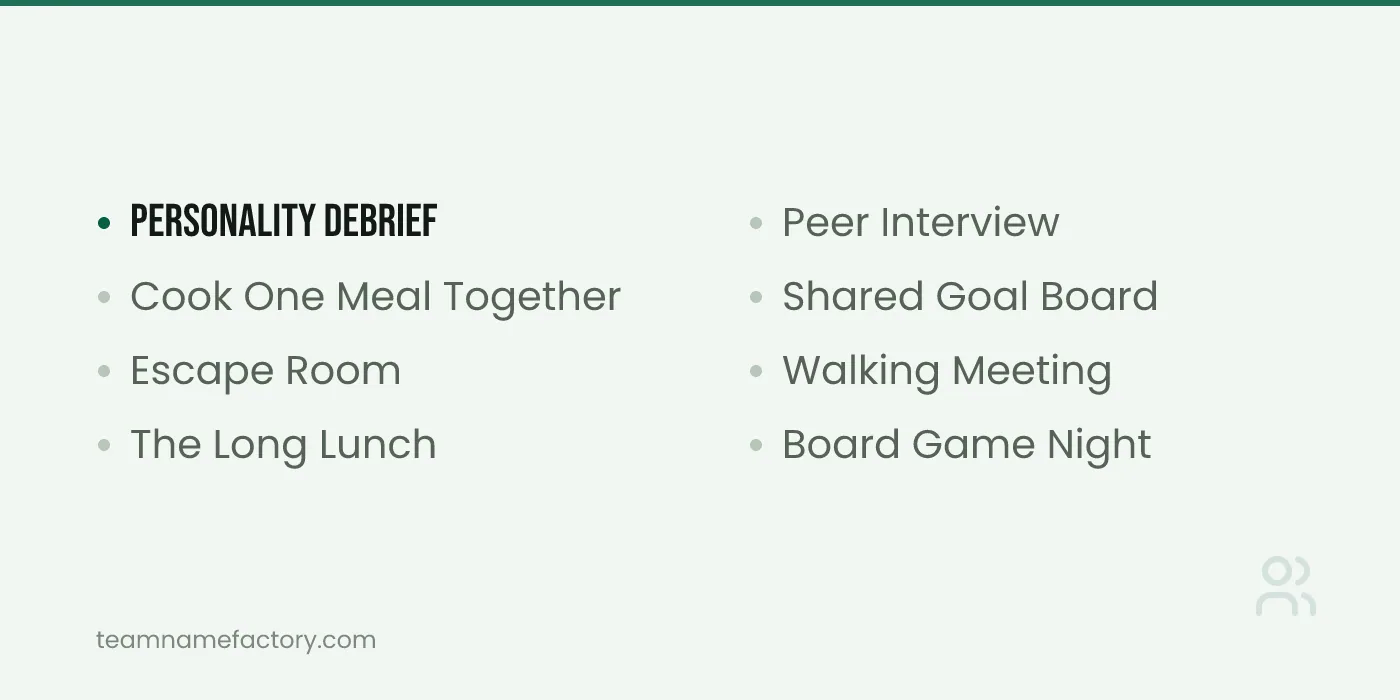
Under about eight people, anything with teams collapses. These team building activities for small groups work when everyone has to participate because there is nowhere to hide.
- Personality Debrief — Everyone takes the same short assessment and the group discusses where they differ. Ninety minutes and it needs a careful facilitator.
- Cook One Meal Together — Not a competition. One dish, divided tasks, eaten together. Two hours.
- Escape Room — A team of four to six is the ideal size, so a small group is an advantage here.
- The Long Lunch — Deliberately unstructured, phones away, ninety minutes. Underrated and free.
- Peer Interview — Pairs interview each other for ten minutes, then introduce their partner to the group. It gets past the job title fast.
- Shared Goal Board — Each person writes one personal and one work goal for the quarter. Revisit it in twelve weeks.
- Walking Meeting — Take a recurring one-to-one or a three-person sync outside. It changes what people say.
- Board Game Night — Small groups suit longer games that a large group cannot run.
Team Building Activities for Large Groups
Above about twenty-five, the constraint is logistics. The best team building activities for large groups run in parallel. They need one instruction everyone hears once, and no phase where most people stand and wait. For remote crowds, virtual team building activities for large groups need breakout rooms rather than one big call.
- Human Bingo — A grid of “find someone who…” squares. Twenty minutes of everyone talking to strangers, and it scales to two hundred.
- Station Rotation — Six activities, six groups, ten minutes each, rotate on a whistle. Parallel by design.
- The Big Quiz — Tables as teams, six rounds, one host. Scales cleanly and everyone stays seated.
- Group Juggle — A circle passes a ball in a fixed order, then more balls are added. Works with up to thirty per circle, run several circles.
- Lip Sync Battle — Teams get thirty minutes to prepare and two to perform. Loud, and observers get a real role as the audience.
- Charity Assembly Line — Packing kits or meals against a target. Two hours, genuinely scales, and it produces something.
- Silent Line-Up — The whole group orders itself by birthday without speaking. Ten minutes, no materials, and it works at almost any size.
- Team Flag Design — Groups of eight design and present a flag in twenty minutes. Cheap, parallel and the presentations are short.
Team Building Activities for Adults
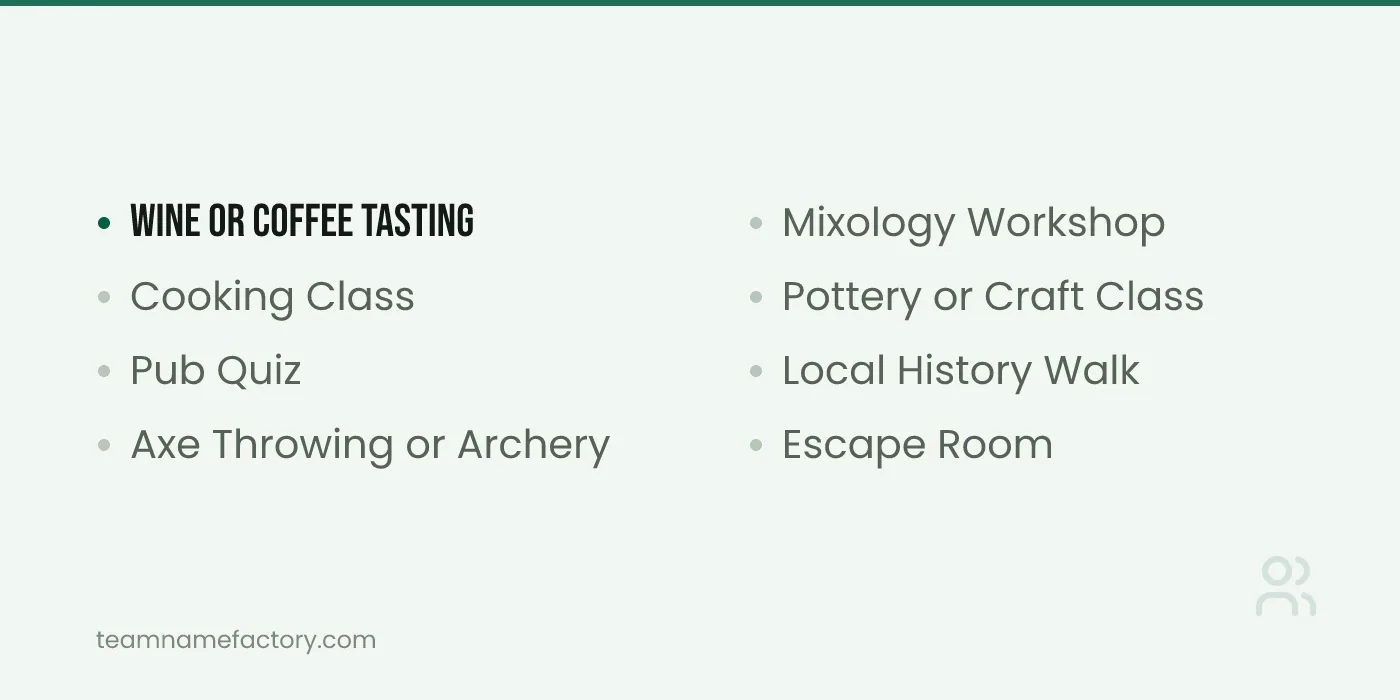
The main thing adults want is to not be patronized. These team building activities for adults assume a room of people with jobs, opinions and limited patience for enforced enthusiasm.
- Wine or Coffee Tasting — A guided tasting with someone who knows the subject. Ninety minutes, and there is an easy non-alcoholic version.
- Cooking Class — A chef-led session where teams work stations. Two to three hours.
- Pub Quiz — Six rounds, mixed tables. The format is familiar enough that nobody needs it explained.
- Axe Throwing or Archery — Supervised, instructor-led, ninety minutes. Novelty does the work.
- Mixology Workshop — Teams make two cocktails against a brief. Ninety minutes.
- Pottery or Craft Class — Slow, quiet and surprisingly good for teams that are burnt out on competition.
- Local History Walk — A guided walk around the area the office sits in. Ninety minutes and it costs almost nothing.
- Escape Room — Still the most reliable paid option for a group of adults who do not know each other well.
Outdoor Team Building Activities for Adults
Combining both constraints. Outdoor team building activities for adults should skip anything that looks like a school sports day unless the group has asked for it. Most corporate outdoor team building activities fail on exactly that point.
- Kayaking or Canoeing — Paired boats force communication immediately. Half a day with an instructor.
- Hiking with a Purpose — A route with a summit or a landmark, not a loop. Three hours, and conversation happens naturally in pairs.
- Outdoor Cooking Challenge — Fire pits or grills, teams, one brief. An afternoon.
- Clay Pigeon Shooting — Instructor-led, highly novel, ninety minutes. Check for anyone uncomfortable with it first.
- Farm or Vineyard Day — A working visit with tasks, then a meal. Half a day.
- Wild Swimming or Beach Day — Low structure, high recovery. Best for teams that have just shipped something hard.
Team Building Activities for Students
Classrooms and clubs need activities that work with no budget and a fixed period. These team building activities for students fit a lesson and need materials you already have.
- Marshmallow Challenge — Works better with students than adults, because they prototype instead of planning.
- Paper Bridge — Teams build a bridge from paper and tape that holds a textbook. Twenty-five minutes.
- Silent Line-Up — Order by birthday without talking. Five minutes, no materials.
- Group Story — One sentence each around the circle to build a story. It gets absurd quickly, which is fine.
- Class Scavenger Hunt — Clues around the school building. One period.
- Debate Relay — Teams argue a position, then swap sides halfway. Thirty minutes, and it teaches more than the debate itself.
- Blindfold Obstacle Course — One student guides another by voice through a simple course. Twenty minutes and it needs a clear floor.
Team Building Activities for Kids
Shorter, more physical and with clearer rules. Good team building activities for kids avoid elimination, because the child who goes out first is the one who most needed to be included.
- Parachute Games — A group parachute and a ball. Endlessly variable and everyone holds an edge.
- Hula Hoop Pass — A circle holding hands passes a hoop around without letting go. Ten minutes.
- Team Relay Races — Short legs so nobody waits long. Mixed teams, no eliminations.
- Build a Fort — Sheets, chairs, clips and twenty minutes. The negotiation is the activity.
- Freeze Dance — Music stops, everyone freezes. Simple, and the youngest groups love it.
- Egg and Spoon Relay — Slow, funny and it rewards care rather than speed.
- Group Juggle — Same as the adult version with softer balls and a smaller circle.
Icebreaker Questions and Games to Open a Session
Not activities in their own right, but the thing that makes the first ten minutes work. Use one, not three.
- What is the best thing you ate this week? — Low stakes, everyone has an answer, and it never gets political.
- What did you want to be at age ten? — Reliably surprising, and it humanizes senior people fast.
- What is a skill you have that nobody here knows about? — This one occasionally reorganizes a team.
- What is your most-used app that is not a work tool? — Modern, specific and it starts side conversations.
- Which fictional workplace would you least like to work in? — Funnier than it sounds and safely impersonal.
- What is the last thing you learned the hard way? — Good for retros, because it gives people permission to admit a mistake.
- Show one photo from your camera roll from this month. — Faster than a question and it works on video calls.
- What is something you have changed your mind about? — The strongest opener for a strategy session.
The Best Team Building Activities: A Shortlist
Want the best team building activities without reading the whole page? These six have the highest hit rate across group types, and five are free.
- Virtual Coffee Roulette — Lowest effort, longest-lasting effect, runs itself once set up.
- Problem Wall — The only one that reliably changes how the team works afterwards.
- Escape Room — The most dependable paid option for a group that does not know each other.
- Volunteer Build Day — The one people still bring up a year later.
- Skill Swap Sessions — Free, repeatable, and it surfaces hidden expertise.
- Human Bingo — The best opener for any group above twenty-five.
How to Run a Team Building Activity That Actually Works
Pick the activity after you name the problem, not before. A team that does not trust each other needs something with shared risk. A team that has never met needs something with structure and a clear end.
Make participation genuinely optional and say so out loud. One person opting out costs nothing. One person forced in poisons the room, and everyone notices.
Keep it inside work hours. An activity scheduled for a Thursday evening reads as unpaid work, however good it is. That single decision changes attendance more than the choice of activity.
Skip the debrief unless something happened. Forcing a lessons-learned discussion onto a game people enjoyed is the fastest way to make them dread the next one. If the activity produced something, like the Problem Wall, then talk about the output instead.
Finally, check accessibility before you announce. Physical activities, food-based sessions and anything involving alcohol all exclude somebody. Ask first, quietly, and have a second option ready.
Frequently Asked Questions
What are the best team building activities for work?
The ones that produce something. A Problem Wall beats any game. The team lists process annoyances and fixes three, which changes how people work the next day. Among the purely social team building activities for work, virtual coffee roulette has the best effort-to-effect ratio.
How long should a team building activity be?
Match it to the slot you already have. Five to ten minutes at the start of a regular meeting works better than a half-day event nobody can schedule. Long sessions are only worth it when the group rarely meets in person.
What are good team building activities for large groups?
Anything that runs in parallel. Human Bingo, station rotations and a table quiz all scale past a hundred people because no one waits for a turn. Silent Line-Up is the best of the quick team building activities for large groups, since it needs no materials. Avoid activities with a single focal point, since most of the room becomes an audience.
Do virtual team building activities actually work?
Yes, if every person has something to do. Breakout rooms of four to six work; a single call with thirty people watching two of them talk does not. Keep virtual team building activities under forty minutes.
What are some quick team building activities for a meeting?
One Word Check-In, Rose Thorn Bud, and Count to Twenty all run in under five minutes with no materials. Use one per meeting rather than rotating through several, because the value comes from the routine.
How do I run team building activities on no budget?
Almost everything on this page is free. Silent Line-Up, Human Knot, Human Bingo, Skill Swap Sessions, walking meetings and every icebreaker cost nothing. The paid options, mainly escape rooms and instructor-led classes, buy novelty rather than effectiveness.
Leave a Reply